Pevensey Castle: One of Britain's Oldest Fortresses
by Dawn Copeman
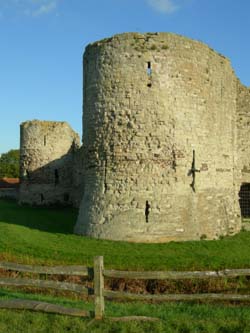 Towards the end of the
Roman occupation of Britain, somewhere between AD290 and AD340,
the Romans set up a fort named Anderida close to the sea at what
is now known as Pevensey in East Sussex. Anderida was unlike
most Roman forts in Britain in that it was built as an oval,
following the shape of the peninsula it was built upon. Most
Roman forts favoured a rectangular layout. When Anderida was
occupied by the Romans the sea came right up to one of the walls,
although the sea has since retreated and is now approximately
four miles away. The majority of the outer walls and the gateways
of this fort are intact today, making it one of the largest
surviving examples of a Roman fort in Britain. When the Romans
left Britain early in the 5th century AD, the fort fell into
disrepair. Towards the end of the
Roman occupation of Britain, somewhere between AD290 and AD340,
the Romans set up a fort named Anderida close to the sea at what
is now known as Pevensey in East Sussex. Anderida was unlike
most Roman forts in Britain in that it was built as an oval,
following the shape of the peninsula it was built upon. Most
Roman forts favoured a rectangular layout. When Anderida was
occupied by the Romans the sea came right up to one of the walls,
although the sea has since retreated and is now approximately
four miles away. The majority of the outer walls and the gateways
of this fort are intact today, making it one of the largest
surviving examples of a Roman fort in Britain. When the Romans
left Britain early in the 5th century AD, the fort fell into
disrepair.
It became important again on the 28th September 1066 when William
of Normandy and his army landed at Pevensey. They set up a
temporary fort inside Anderida and used it to rest and plan
before the battle of Hastings. Pevensey castle is in fact
depicted in one of the early scenes in the Bayeux Tapestry. After
defeating King Harold at the Battle of Hastings, King William
gave the castle to his half-brother, Robert, Count of Mordain.
He built a stone keep and bailey fortress in one corner of the
Roman fort and repaired the walls where necessary. Over the
centuries a moat and drawbridge were added and the gatehouse was
built in the thirteenth century.
The castle was a good defensive stronghold and survived sieges in
1088 by William Rufus and in 1147 by King Stephen, but was badly
damaged by King John in 1216. It was rebuilt and remained in use
until the 15th century, when it was used as a prison. A grisly
reminder of this time is the 'oubliette,' a deep pit in the
ground, just inside the entrance to the castle. It finally
decayed to ruin in the 18th century.
Since then it has remained mostly unoccupied except during times
of war, when its defensive position made it useful again. It was
used as a gun emplacement in 1588 during the threat of the
Spanish Armada, and during the Second World War American and
Canadian troops were stationed there to protect against shore
landings. The towers were once again fortified to protect the
troops from enemy bombardment, and these new fortifications were
carefully blended with the Roman walls so that the enemy would
not guess that there were troops stationed there.
In 1925 the Duke of Devonshire, the last owner of Pevensey Castle
and incidentally the owner of most of nearby Eastbourne, gave the
castle to the nation. Today Pevensey Castle is managed by
English Heritage and is one of its most visited sites. Visitors
can cross the drawbridge, climb the walls, view the towers and go
into the dungeons whilst listening to a detailed commentary on
the history of the site on an 'audio wand.' Entry to the Roman
fort is free; entry to the castle costs: £3.50 per adult,
£2.60 for seniors and £1 for children aged five and
over. Children under five get in for free. There is parking
available nearby, for which a charge is payable, currently
£1 and refreshments can be purchased from the kiosk inside
the castle or from the Castle Cottage tearoom and restaurant next
to the car park.
Related Articles:
- The Ghosts of Pevensey Castle, by Elizabeth Wright
- https://www.timetravel-britain.com/articles/castles/pevensey2.shtml
More Information:
We regret that we no longer have the resources to maintain up-to-date links and/or hours and pricing details for the various sites and attractions listed on this website. For more information about the location(s) listed above, please use your favorite search engine or visit Wikipedia.
Dawn Copeman is a freelance writer and commercial writer who has had more than 100 articles published on travel, history, cookery, health and writing. She currently lives in Lincolnshire, where she is
working on her first fiction book. She started her career as a freelance
writer in 2004 and has been a contributing editor for several publications, including TimeTravel-Britain.com and Writing-World.com .
Article © 2005 Dawn Copeman
Photos © 2007 Patrick D. Allen
|